
Entrance workflow before devices
Resident, employee, vendor, delivery, emergency, and visitor paths are defined before readers or stations are chosen.
Commercial Technology Solutions | Ocala and Marion County
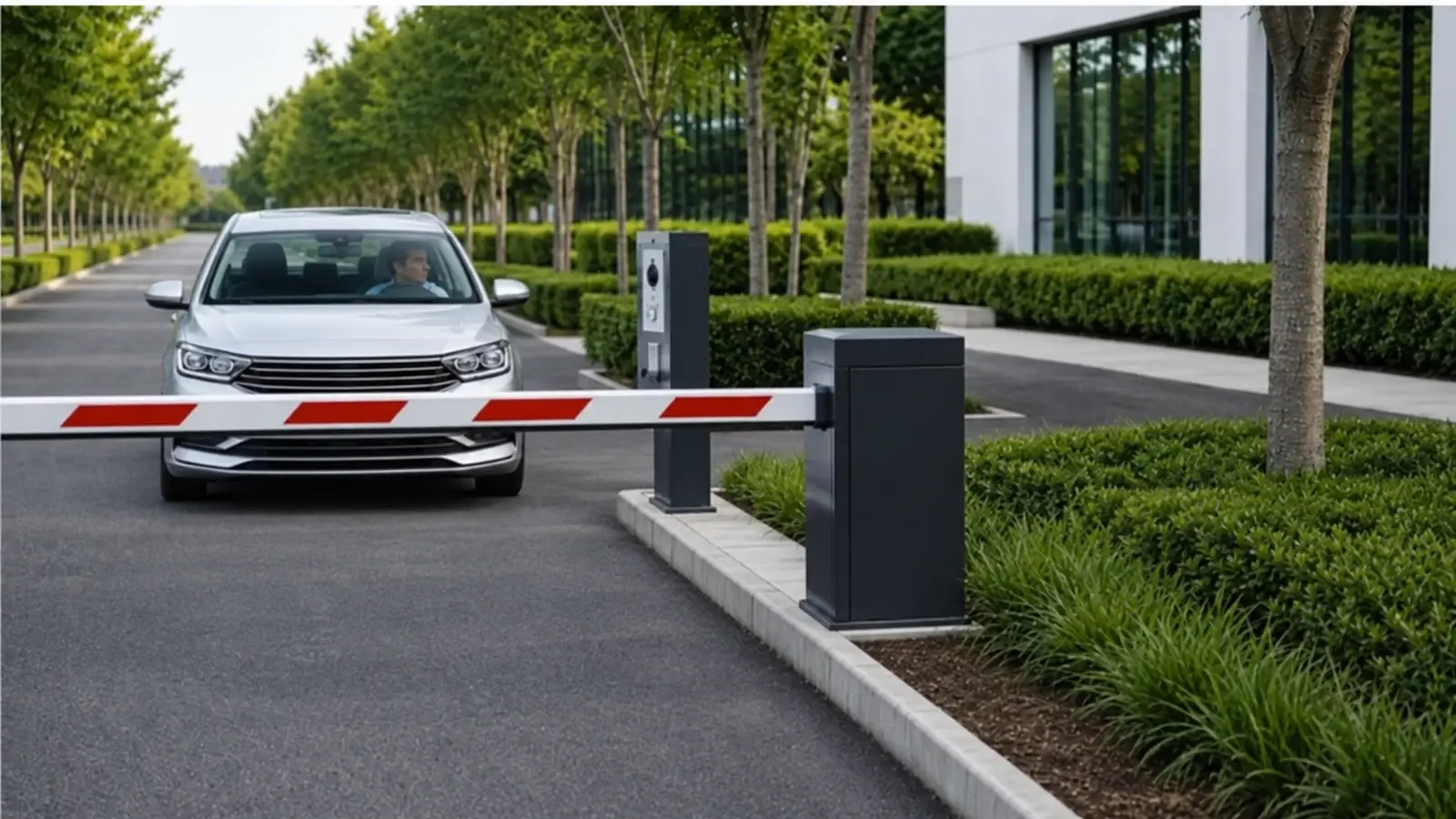
Gate access coordinates the technology around a vehicle or property entrance: how a driver requests entry, how credentials are checked, how an authorized person verifies the event, and how the approved gate-operator interface receives a release. The scope must also account for vehicle position, remote location, power, network, intercom, cameras, and operating procedures.
The entrance must work for real vehicles and real staff decisions. Long driveways, trailers, queues, remote gates, after-hours calls, operator controls, detection, and visual context make this a property-entry system rather than a door-access variation.
Resident, employee, vendor, delivery, emergency, and visitor paths are defined before readers or stations are chosen.
Compatibility and release behavior are confirmed with the existing gate equipment and responsible gate professionals.
Intercom, cameras, credentials, and event records are coordinated so authorized staff can understand the entrance event.
FL License #EC13016138 is presented without claiming mechanical gate fabrication, guaranteed compatibility, or guaranteed plate reads.
Drivers approach at different speeds and positions, visitors may block traffic while calling, trailers need clearance, and the gate may be far from staff and network equipment. The entry design must reflect lane geometry, queuing, operator controls, detection, safety devices, communication, verification, and the property’s release policy.
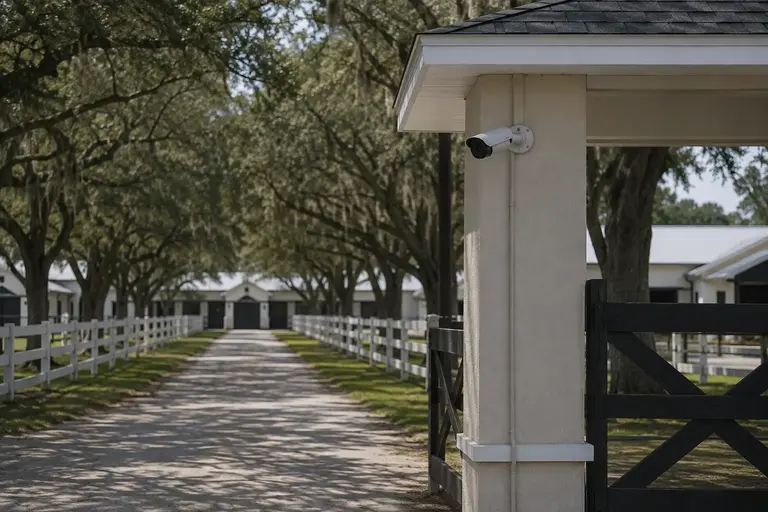
An existing operator may lack the expected inputs, documentation, capacity, condition, or approved compatibility for new access equipment.
Remote entrances often need a deliberate fiber or outdoor wireless path, local power, surge/grounding coordination, and serviceable enclosures.
Loops, probes, photo eyes, position sensors, and other devices serve different presence, exit, obstruction, or safety roles; selection cannot be reduced to a generic sensor.
Glare, headlights, plate angle, vehicle speed, weather, obstructions, and camera position affect visual and LPR-related results.
Support approved cards, transmitters, mobile credentials, codes, or other methods when the selected platform and operator interface allow them.
Connect visitors with an authorized answering point and deliver an approved release request to the entry system.
Document control inputs, gate state, open/close behavior, extended-open needs, power, and responsibilities with the gate equipment provider.
Coordinate devices used for exit, presence, approach, obstruction, or other defined functions within the approved gate design.
Use appropriate entrance views and event association to help authorized staff review a vehicle entry; plate capture is condition-dependent.
Provide local switching and a planned fiber or point-to-point path when the entrance is separated from the main property network.
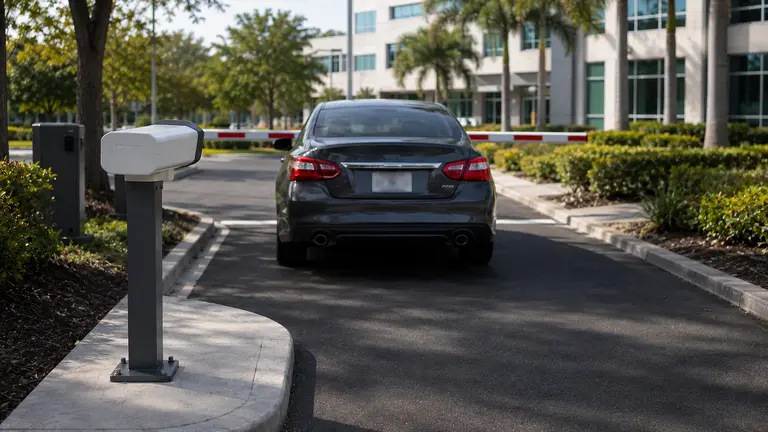
Coordinate staff, owners, vendors, trailers, deliveries, long driveway communication, and visual verification at a remote gate.
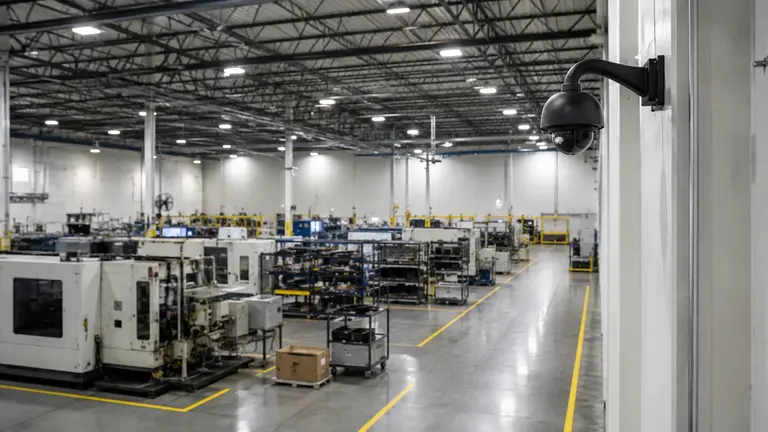
Manage employee and vendor vehicles while preserving truck movement, service access, lane visibility, and after-hours procedures.
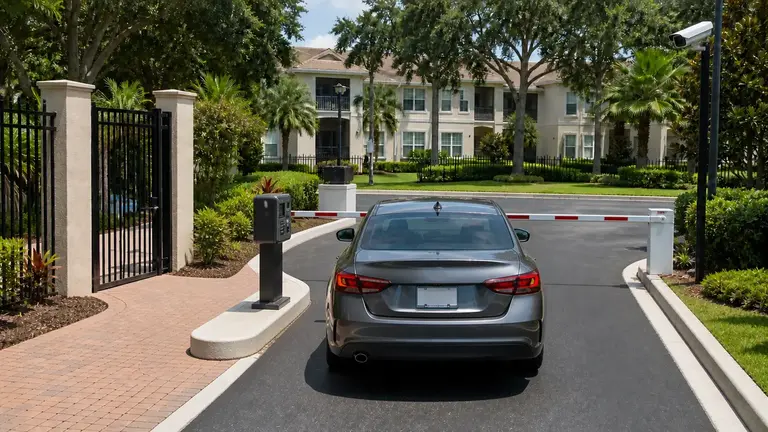
Connect residents or staff with visitors through credentials, directory or intercom workflow, camera context, and event records.
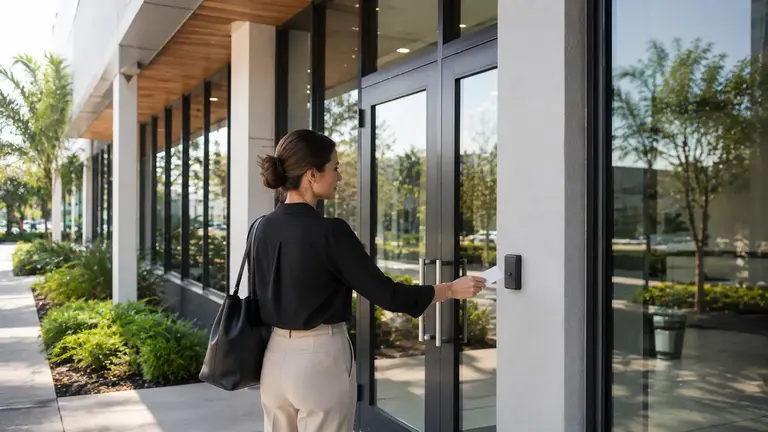
Separate delivery and contractor entry from public parking while giving authorized operations staff a clear release process.
Observe vehicle approach, lane, stacking, turnaround, trailer clearance, visitor dwell time, authorized groups, and after-hours response.
Identify operator, controls, safety devices, condition, manuals, power, enclosures, communication paths, and responsible vendors.
Define credentials, intercom, cameras, detection, event handling, fiber or wireless backhaul, local network, and remote administration.
Test defined vehicle scenarios, release paths, credential behavior, communication, gate state, camera context, event records, and loss-of-service procedures.
Access credentials can identify authorized drivers, intercom lets visitors call, cameras provide context, and LPR-related tools may associate plate information when scene conditions support it. Fiber or point-to-point wireless can connect the entrance, but none of these components substitutes for the gate operator and safety design.
Horse farms, training facilities, industrial yards, communities, and large commercial sites can place the gate far from the people making entry decisions. The design should account for long driveways, trailers or service vehicles, outdoor exposure, remote communications, and the daily difference between employees, residents, vendors, and visitors.
Coordinate shared credential administration while keeping controlled-door hardware and permissions in their own scope.
Design the visitor call, answering, and approved remote-release interaction at the entrance.
Extend network service to a remote gatehouse or entrance when the outdoor RF path is suitable.
Owners, property managers, community staff, industrial operators, equestrian facilities, and authorized security personnel use gate-entry systems; gate operator repair and mechanical fabrication require the appropriate separate scope.
Map approach, lanes, stacking, vehicle types, visitor dwell, gatehouse use, and remote distance.
Document the gate equipment, safety devices, controls, power, enclosure, network, and responsible parties.
Coordinate credentials, keypad, intercom, detection, camera context, event records, and backhaul.
Run employee, visitor, vendor, exit, remote-release, after-hours, and loss-of-service procedures with authorized stakeholders.
Ocala Security Cameras by Data Pro Communications is operated by Data Pro Communications for the Ocala Branch. Contact information: 603 E Fort King St, Ocala, FL 34471; (352) 517-4404; info@dataprocommunications.com. FL License #EC13016138.
Questions and answers
A vehicle gate adds operator controls, traffic flow, lane position, detection, safety devices, remote communications, weather, and property-entrance procedures. Credentials may be shared, but the complete workflows are different.
Compatibility must be confirmed from the operator, control inputs, condition, documentation, power, safety design, and responsible gate professional. No universal interface should be assumed.
Depending on the approved platform, the entrance may use transmitters, cards, mobile credentials, keypads, directories, intercom release, staffed controls, or other methods. Each option changes administration and driver behavior.
Cameras can provide visual context when placement, lighting, scene, network, recording, and event timing support the workflow. They do not guarantee identification of every driver, vehicle, or plate.
Plate size in the image, angle, distance, lane position, speed, shutter and exposure, headlights, lighting, weather, obstructions, plate condition, and camera purpose all matter. Results cannot be guaranteed.
A physical fiber backbone may be used where a pathway exists, or an outdoor point-to-point link may be considered when the RF path is suitable. Power, local switching, protection, capacity, and maintenance access also matter.
Gate Access & Entry Systems can coordinate low-voltage entry control, communication, verification, and approved interfaces to compatible gate operators. Mechanical fabrication, structural gate work, and operator-specific mechanical repair require the appropriate gate professional unless separately authorized.
The owner should define local credential behavior, intercom limitations, staffed or alternate entry procedures, emergency access responsibilities, event buffering, and how the entrance is restored. Cloud-dependent functions may be unavailable.
The design can use scheduled credentials, call-based release, gatehouse verification, directories, or approved temporary methods. The process should minimize shared codes and preserve a clear revocation path.
Provide gate and operator details, lane layout, vehicle types, access groups, visitor and delivery flow, intercom needs, detection devices, cameras, power, network path, gatehouse role, and known safety or mechanical issues.
Request an entrance review covering the operator interface, traffic, credentials, intercom, detection, camera context, backhaul, and event handling.